
MLB Bankroll Management: A UK Punter’s Sustainable Staking Plan
 Available in US
The Bankroll Conversation No Tipster Has
I learned bankroll management by losing one. Three weeks into my second MLB betting season I was up 18 percent, convinced the model was working, and I doubled the stake size on what I thought was a high-confidence position. The bet lost. The next bet lost. I was down 22 percent against my opening figure within four days, and I had to rebuild confidence as much as capital. The lesson was permanent. Stake discipline is not a side dish to bet selection. It is the meal.
The MLB regular season runs 162 games per team and 2,430 games at the league level. A UK punter betting selectively across that schedule will place between 200 and 600 positions in a typical season, depending on confidence threshold and time availability. Across that volume, the difference between sustainable bankroll management and ad-hoc staking is the difference between ending the season with a positive return and ending it explaining to oneself why the analytical work did not pay off. The £5 per spin and £2 per spin (for ages 18-24) limits introduced for online slots in 2025 reflect a regulatory recognition that staking discipline matters; the same recognition needs to be internalised by the sports-betting punter.
This guide pulls apart the unit-sizing logic that anchors every position to the bankroll, the trade-off between flat and proportional staking, the drawdown rules that protect the bankroll across the long MLB season, and a worked example of a 12-week MLB plan that demonstrates the framework in operation. The goal is to give the UK punter a staking system that survives variance and compounds across the full season.
Unit Sizing – The 1 to 3 Percent Logic
The unit is the foundation of bankroll management. A unit is a single fixed share of the total bankroll, and every bet is sized as a multiple (or fraction) of that unit. The unit is the punter’s daily working currency, and every position references it.
The recommended unit size for an MLB-only UK punter sits between 1 percent and 3 percent of the total bankroll. The conservative end of the range (1 percent) is appropriate for newer punters, punters with low confidence in their bet-selection model, or punters who place high volumes (300+ bets per season) where the smaller unit absorbs variance gracefully. The aggressive end of the range (3 percent) is appropriate for experienced punters with documented edges, smaller bet volumes, and the psychological capacity to absorb a 20 percent or 25 percent drawdown without reactive sizing changes.
A £2,000 starting bankroll at 2 percent unit-sizing yields a £40 unit. Standard bets are placed at one unit (£40). Higher-confidence bets at 1.5 to 2 units (£60 to £80). Lower-confidence bets at 0.5 units (£20). Bets below 0.5 units are skipped – the analytical work to identify the position is not justified by the £20 stake size. The unit-sizing framework forces the punter to stake confidence rather than emotion, and the discipline shows up in the seasonal ROI.
The unit recalculation rule matters as much as the initial sizing. The unit should be recalculated against the current bankroll at fixed intervals – most punters use weekly or monthly recalculation. Daily recalculation is too reactive and produces compounding error in both directions. Annual recalculation is too lagging and means the punter is staking units sized for last winter’s bankroll. Weekly recalculation is the standard for active MLB punters; monthly recalculation works for lower-volume punters.
Flat Staking vs Proportional
The choice between flat staking and proportional staking is the most consequential decision in the bankroll framework, and it is also the most commonly misunderstood. The two approaches produce different long-term outcomes and suit different punter profiles.
Flat staking means every bet is placed at one unit (or some fixed multiple of one unit determined by confidence tier). The unit itself is recalculated weekly against the current bankroll, but within the week, every position is the same flat stake. Flat staking has two advantages – it is mechanically simple, and it suppresses the variance amplification that affects proportional staking when a hot or cold streak compounds against the punter’s psychology.
Proportional staking means the stake on each bet scales with the perceived edge on that bet, calculated using the Kelly criterion or a fractional-Kelly approximation. A bet with a perceived 5 percent edge at decimal 1.91 receives a larger stake than a bet with a perceived 2 percent edge at the same price. Proportional staking maximises long-run growth when the edge estimates are accurate, but it amplifies the consequences of poor edge estimation. A punter overstating his edges with proportional staking will lose bankroll faster than the same punter using flat staking with the same edge errors.
The MLB-specific consideration is that the league’s 2,430-game volume produces enough sample size for honest edge estimation, but the variance within that sample is high. The right approach for most UK MLB punters is fractional-Kelly proportional staking – using the Kelly formula to identify the proportional stake but applying a one-quarter or one-half multiplier to soften the variance. The result is a staking pattern that scales with confidence (the Kelly logic) but does not punish edge-estimation errors (the fractional damping). The fractional-Kelly approach is meaningfully better than flat staking when edge estimation is honest, and it does not catastrophically underperform flat staking when edge estimation is rough.
Drawdown Rules and the 162-Game Sample
A drawdown is a peak-to-trough fall in the bankroll. Drawdowns are inevitable across an MLB season, and the punter who treats every drawdown as a signal to change strategy is a punter who will compound errors. The discipline is to define drawdown rules in advance and follow them mechanically when the rules trigger.
A 10 percent drawdown is normal variance. The bankroll has slipped from £2,000 to £1,800; no action is required. A 20 percent drawdown is a signal to pause and review. The bankroll has slipped from £2,000 to £1,600; the punter takes a 48-hour break from placing new positions, reviews the last 50 bets to assess whether the drawdown reflects model deterioration or normal variance, and either continues with adjusted unit-sizing (against the new £1,600 bankroll, the unit drops from £40 to £32) or pauses for a week to reset. A 30 percent drawdown is a signal to stop. The bankroll has slipped from £2,000 to £1,400; the punter stops MLB betting until the underlying issue is identified and corrected, whether that issue is model failure, emotional control failure, or external life pressure leaking into the betting decisions.
The 162-game team schedule and 2,430-game league schedule give the variance the room to express itself. A punter betting at sound edge can experience 30-bet losing streaks across the season; the streak does not by itself mean the model has failed. The drawdown rules separate normal variance (which is absorbed by the framework) from real signal (which the punter must respond to). Most MLB punters experience two or three 20 percent drawdowns across a season and one 30 percent drawdown if the season runs unfavourably. The framework is designed to handle the realistic worst case rather than a fantasy of monotonic gains.
The drawdown framework also interacts with the responsible-gambling tools that UK operators provide. Deposit limits, time-out features, and self-exclusion options are not just regulatory furniture – they are operational tools that support the drawdown rules. A punter whose 30 percent drawdown trigger fires can use a 30-day deposit pause to enforce the stop on himself rather than relying on willpower. The safer-bet framework documents the tooling. Bankroll management without those tools is harder; bankroll management with those tools becomes systematic.
A Worked Example – A 12-Week MLB Plan in Decimal Odds
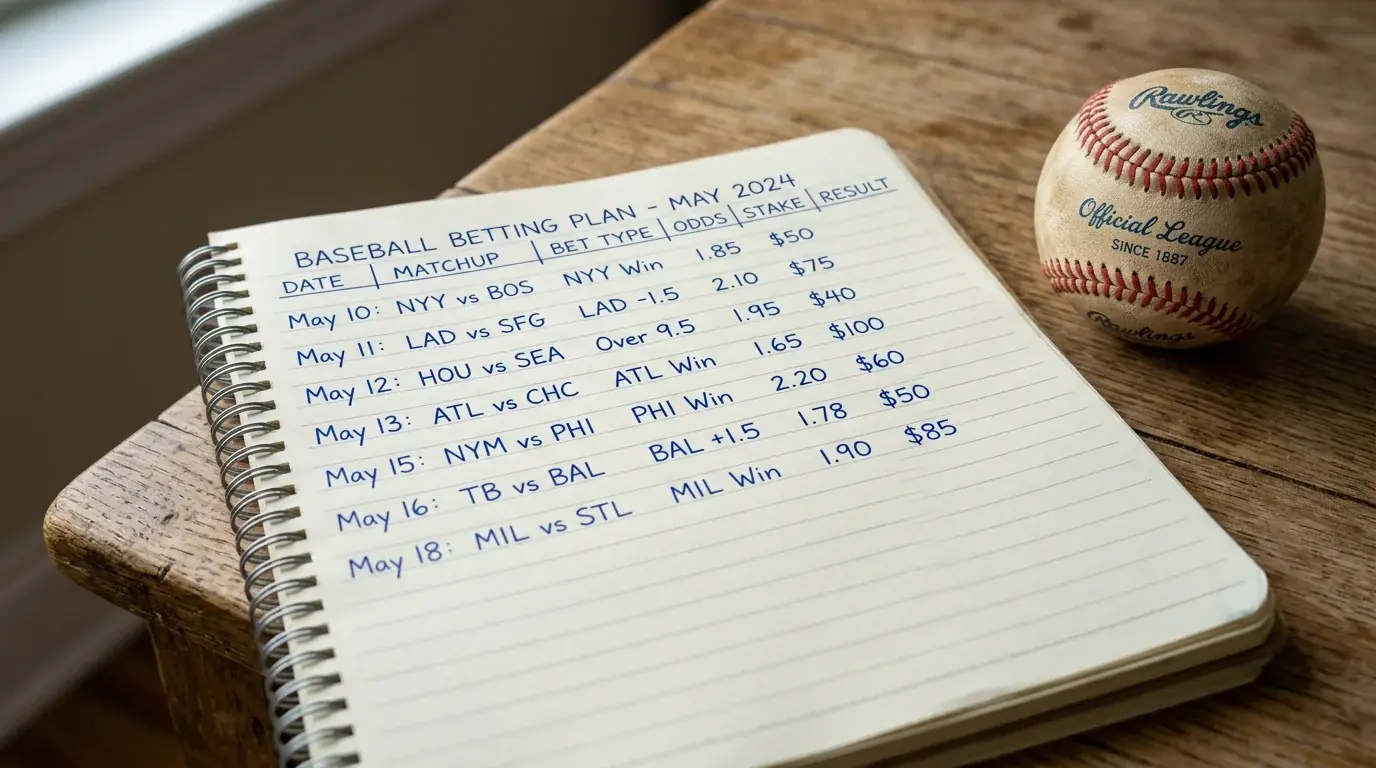
Consider a UK punter starting an MLB season with a £2,000 bankroll, targeting 250 bets across the regular season (roughly 21 bets per week across 12 weeks of focused betting), at average decimal price 1.91, using flat staking at 2 percent (£40 unit) recalculated weekly.
Week 1: 20 bets at £40 = £800 staked. Hit rate 55 percent, return £836, profit £36, bankroll up to £2,036. Unit recalculated to £40.72; rounded to £40 for the next week.
Week 4: cumulative bankroll £2,140 after a strong run. The unit has risen to £42.80 across the recalculation cycle. £40 stakes are now slightly under-sized; the next-week unit moves to £43.
Week 7: drawdown of 18 percent from peak. Bankroll has fallen from £2,140 to £1,755. The unit recalculates to £35; the 20 percent drawdown rule has not yet triggered. The punter continues at the lower stake size.
Week 9: bankroll recovers to £1,920. Unit moves to £38. The recovery has been gradual but the framework absorbed the drawdown without panic adjustment.
Week 12: closing bankroll £2,210. Total profit across the 12 weeks £210 against a £2,000 starting bankroll – 10.5 percent ROI on a 250-bet season. The framework supported the punter through the drawdown, the unit recalculation captured the gradual gains, and no week saw the punter staking outside the disciplined range. The seasonal outcome reflects sound bet selection, but the bankroll framework is what allowed the bet selection to express itself across the variance.
Bankroll Questions UK Bettors Ask
Two questions dominate the reader inbox on bankroll management. One asks what unit size makes sense for an MLB-only punter. The other asks whether to scale stakes up after a winning week. Both deserve direct answers because both touch the discipline that protects the bankroll across the variance of a 162-game season.
What unit size makes sense for an MLB-only UK bettor?
The recommended unit size for an MLB-only UK punter sits between 1 percent and 3 percent of the total bankroll. New punters or high-volume punters (300+ bets per season) should sit at the conservative 1 percent end of the range; experienced punters with documented edges and smaller bet volumes can run at 2 to 3 percent. The unit should be recalculated weekly against the current bankroll. A £2,000 bankroll at 2 percent unit-sizing yields a £40 standard unit, with higher-confidence bets sized at 1.5 to 2 units and lower-confidence bets at 0.5 units.
Should I scale stakes up after a winning week?
Only via the weekly unit recalculation, not via aggressive in-week scaling. Weekly recalculation captures the bankroll growth automatically – if the bankroll rises from £2,000 to £2,200, the next week’s 2 percent unit moves from £40 to £44. Aggressive in-week scaling (doubling stakes after a winning streak, for instance) is the most common cause of catastrophic drawdowns among MLB punters. The discipline is to let the unit recalculation do the scaling and to keep within-week stakes anchored to the recalculated unit.
Created by the ”Betting on Baseball Tips” editorial team.