UK Licensed Sportsbooks for MLB: Markets and Margins
 Available in US
Evaluating UK Sportsbooks: Margins and MLB Market Depth
Years ago, before the current licensing framework had its full teeth, a colleague of mine spent six months betting at an unlicensed offshore book because the prices were a half-point better than what the UK operators offered. The book then changed its withdrawal terms unilaterally, and his £4,200 balance evaporated into a multi-step verification process that never quite resolved. He has not bet anywhere unlicensed since, and neither have I. The decimal-price differential at unlicensed operators is real; the cost of recovery when something goes wrong is far larger.
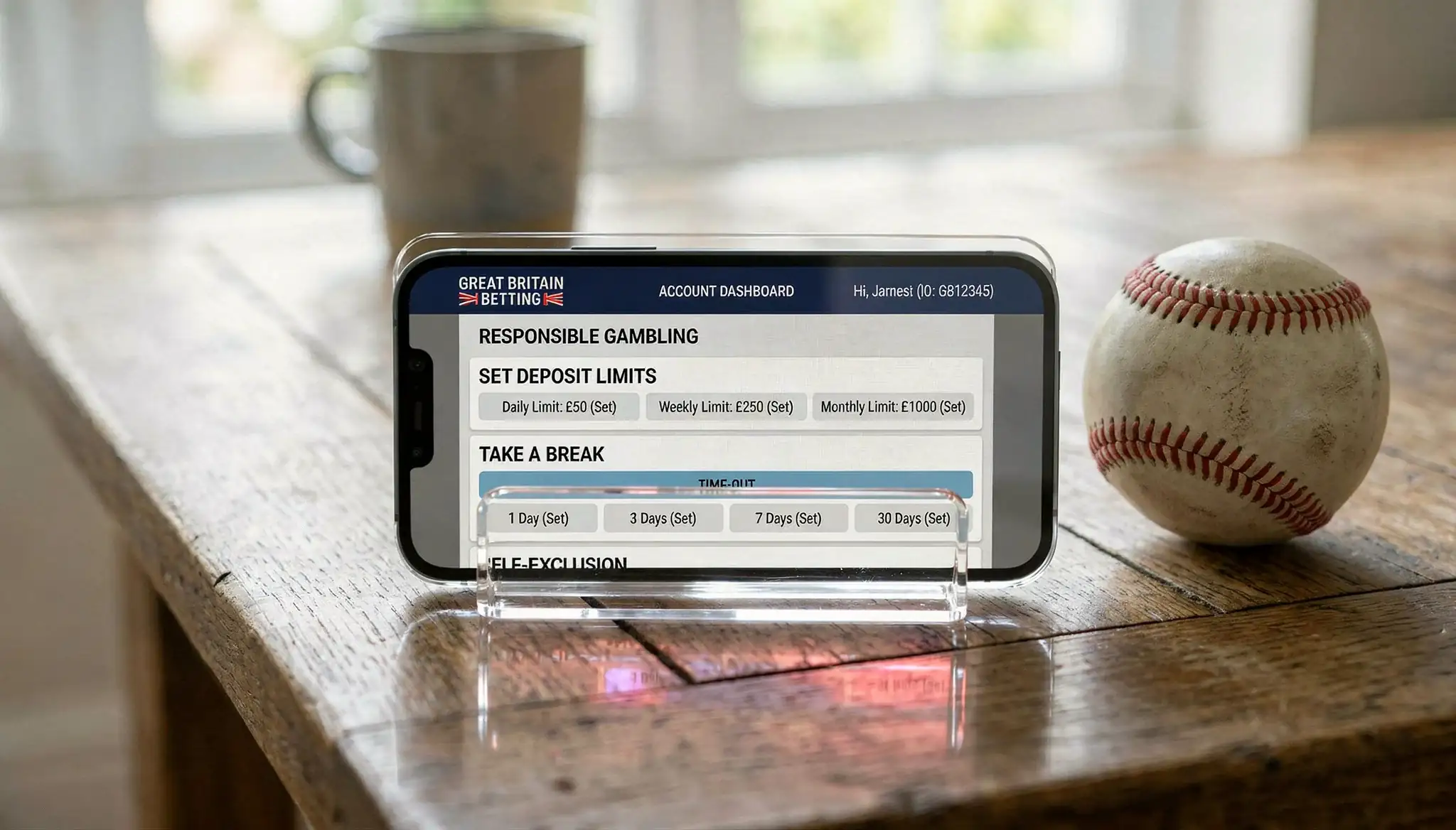
The basic test for any UK sportsbook accepting MLB wagers is simple: it must hold a remote operating licence from the UK Gambling Commission. The Commission’s database lists every licensed operator, and verification takes thirty seconds. As of late 2025, the UK had 8,254 licensed gambling premises and 5,782 betting shops, and the online side runs into the dozens of distinct licensed operators. The licence is the floor, not the ceiling – every other consideration assumes you have already cleared this bar.
Market Depth: Beyond Run Line and Total
The first thing I check at any UK book before opening an account is the depth of MLB markets – how many distinct wagers it offers per game beyond the headline run line, moneyline and total. The leading operators carry forty or more markets per fixture, including F5 lines, NRFI/YRFI props, hit props, strikeout props, alternate run lines, and same-game accumulators. Mid-tier operators offer fifteen to twenty markets per fixture. The thinnest operators run the bare moneyline-and-total minimum, occasionally adding a run line.
Market depth correlates with price quality, mostly because deeper markets mean deeper risk-management and tighter overall vig. A book offering only three MLB markets per game is doing so because it does not have the pricing infrastructure for the rest, and the three markets it does offer typically run wider vig as compensation. Conversely, a book offering forty markets per game has built the back-end infrastructure properly and is competing on price across the full slip.
Player-prop coverage is the meaningful differentiator. UK books vary widely on which player props they offer, and the same player prop can be priced 0.10 to 0.20 decimal points apart at two different operators. The home-run prop, the hit prop, the strikeout prop and the total-bases prop are the four main props worth shopping; not every UK book offers all four. For HR-prop specifically, fewer than half the major UK operators publish daily HR-prop lines for the full MLB slate.
Futures coverage is another split. The major UK books cover World Series outright odds, division winners, and AL/NL pennants. Coverage of MVP and Cy Young futures is patchier – perhaps half the major operators publish these. Specialty futures like rookie-of-the-year, manager-of-the-year, or season-leader props are covered by only a handful of operators. If you want the full futures slate, you usually need accounts at three or four UK books rather than one.
In-play market depth varies most dramatically of all. Some UK books support 50+ live markets per MLB game; some support only the moneyline and the runs total. The difference is essentially whether you can bet the next half-inning, the next at-bat, the next pitch, or only the full game outcome.
Decimal-Odds Margin Across UK Books
Vig – the book’s margin embedded in the decimal price – is the single most important number to compare across operators. UK MLB run-line vig typically sits between 4 % and 7 %; UK MLB moneyline vig between 3.5 % and 6 %; UK MLB total-runs vig between 4 % and 7 %; UK MLB player-prop vig between 6 % and 12 %. Those ranges are wide enough that the difference between a tight UK book and a wide UK book on the same fixture is meaningful.
I keep an informal running list of which UK books are tight on which markets. One operator may run market-leading run-line prices but carry wider total-runs vig; another may be the inverse. There is no single “best UK book for MLB” – there is only “best UK book for the specific market type I am about to bet.” Identifying which book is tightest on which market type is the work of any sustained MLB punter.
Margin patterns shift through the day too. Pre-match prices tend to be tightest at peak betting volume, which for MLB on UK books is roughly 19:00 to 23:00 BST as the US slate fills out and US sharp money pushes prices toward equilibrium. Prices opened on Monday morning UK time, six hours before US sharps weigh in, are generally less efficient and offer more line-shopping opportunity, though they also carry more risk of moving against you.
For deeper coverage of how decimal-odds notation differs from the American notation US-trained punters know, the odds-conversion workshop captures the cross-Atlantic mechanics. The relevant point here is that UK books quote decimal exclusively, and the implied-probability comparison is the only way to evaluate which book is offering the best price.
One specific pattern worth flagging: UK books tend to price the run line slightly tighter on home favourites than on away favourites, because public money in the UK leans toward home favourites and the books need to match that flow. The away favourite at the same numerical price is often a marginally better bet on UK books, simply because the implied probability is closer to fair on away sides.
In-Play MLB Coverage and Latency
In-play coverage at UK books is uneven and the latency between live action and price update varies meaningfully. The leading UK operators refresh in-play prices every pitch or every batter, with median latency between live-broadcast event and price update sitting around 6 to 12 seconds. Mid-tier operators refresh every half-inning, with latency between 30 and 60 seconds. Thin operators offer in-play only as a binary – game stopped, prices suspended, prices restored – with no granular live updates.
The latency is structural. UK books receive data feeds from the same sources but apply different processing delays, and they suspend prices around any swing in the game state – a runner reaching base, a pitching change, a review. The “suspended” state can last anywhere from 5 seconds at the fastest operators to several minutes at the slowest, and during that window no in-play wager can be placed. For a sharp UK punter watching the broadcast in real time, fast suspension cycles are an edge; slow suspension cycles are a frustration.
The actual broadcast UK punters watch is a separate question. MLB has a 2025 broadcast deal with BBC Sport and TNT Sports sharing UK rights, with TNT Sports continuing as the partner in 2026. The broadcast feed has its own latency, typically 10 to 20 seconds behind the live ballpark feed, which means the in-play price you see at a UK book may already be reacting to a play you have not yet seen on screen. That gap cuts both ways and is worth understanding before staking on a live moneyline mid-inning.
The London Series in 2024 drew 108,956 spectators across two days at London Stadium, generating a £56.5 million direct economic impact for the capital – and during those two days, in-play MLB betting on UK books reached its highest volumes of the year, with operators reporting suspension cycles and price refreshes far more frequent than typical late-night MLB games. The market simply works better when the action is in UK time.
Worked Example: Same Bet at Three UK Books
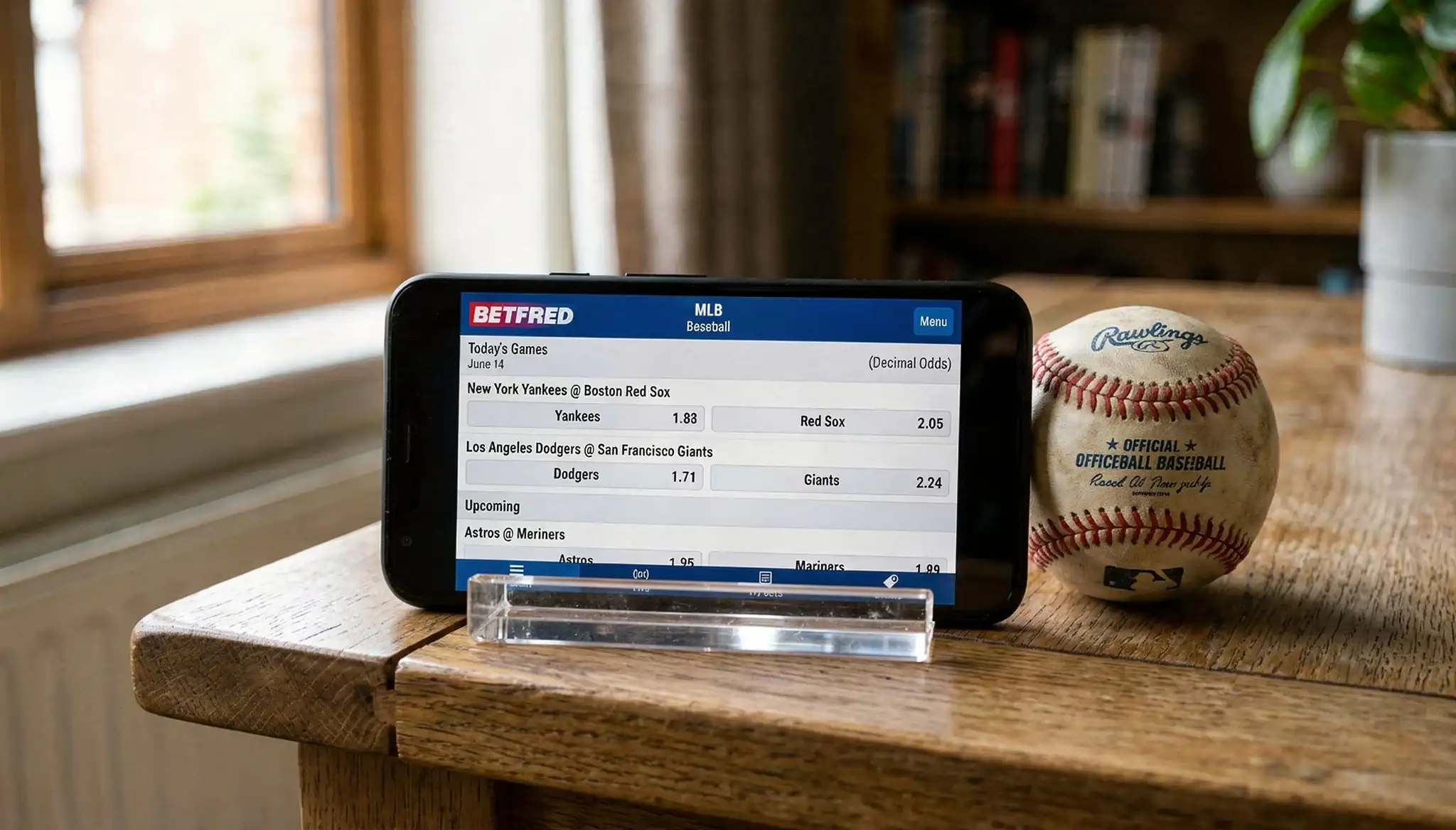
Suppose I want to back a heavy MLB favourite on the run line at -1.5. I check three UK-licensed operators. Book A offers 2.10. Book B offers 2.05. Book C offers 2.00. Same bet, three different prices.
The implied probability at 2.10 is 1 ÷ 2.10 = 0.476, or 47.6 %. At 2.05, the implied probability is 0.488, or 48.8 %. At 2.00, the implied probability is 0.50, or 50 %. The same wager – a -1.5 ticket on a heavy favourite – is being priced as needing 47.6 %, 48.8 %, or 50 % real probability to break even, depending on which UK book takes the bet.
If my own model rates the favourite at 51 % to cover, all three prices have positive expected value, but Book A at 2.10 has the largest edge: 51 % real against 47.6 % implied is a 3.4-point overlay. Book C at 2.00 is essentially a coin-flip break-even at 51 % real against 50 % implied, with a 1-point overlay. The same £20 stake produces meaningfully different expected returns: £42 returned at 2.10, £41 at 2.05, £40 at 2.00. That £2 gap per bet, compounded across two hundred bets per season, is £400 of edge that exists if you shop and disappears if you do not.
The discipline is therefore: never place a UK MLB bet at a single book without checking the line at one or two competing UK operators first. This takes ninety seconds with two browser tabs open, and it captures the line-shopping value the casual punter routinely surrenders. The same principle applies whether you are line-shopping the run line, the total, the F5, or any player prop – the decimal-price gap across UK operators is consistently big enough to justify the check.
One important caveat: line shopping has limits. If your account at Book A has a stake limit of £20 and your account at Book B has £200, the better-priced limit at Book A may not absorb the full position you wanted to place. Coverage at high stake sizes is narrower than coverage at recreational sizes, and the leading UK book at low stakes may not be the leading UK book at high stakes.
UK-Sportsbook Questions Bettors Ask
Readers ask me two questions repeatedly about UK MLB sportsbooks. One is mechanical – how do I verify a licence – and the other is structural – does every UK book actually cover MLB throughout the season. Both deserve clean answers.
How do I check if a UK sportsbook is properly licensed for MLB betting?
The UK Gambling Commission maintains a public register of licensed operators, searchable by operator name. A UK-licensed sportsbook will display its licence number in the footer of its website, and the licence number can be cross-checked against the Commission register in under a minute. As of late 2025, the UK had 8,254 licensed gambling premises and 5,782 betting shops, with online operators numbering in the dozens. Any sportsbook accepting UK customers without an active Commission licence is operating outside the regulated framework and outside meaningful consumer protection.
Do all UK sportsbooks cover MLB futures throughout the season?
No, MLB futures coverage at UK-licensed sportsbooks is uneven. The major operators cover World Series outright odds, division winners and AL/NL pennants throughout the season. Coverage of MVP and Cy Young futures is patchier – roughly half the major operators publish these markets continuously, and some take the markets down between major news events. Specialty futures like rookie-of-the-year or season-leader props are limited to a handful of operators. Holding accounts at three or four UK-licensed sportsbooks is typically necessary to access the full futures slate.
Published by the Betting on Baseball Tips team.