
UK RGD 2026 Betting Impact: MLB Decimal Odds
 Available in US
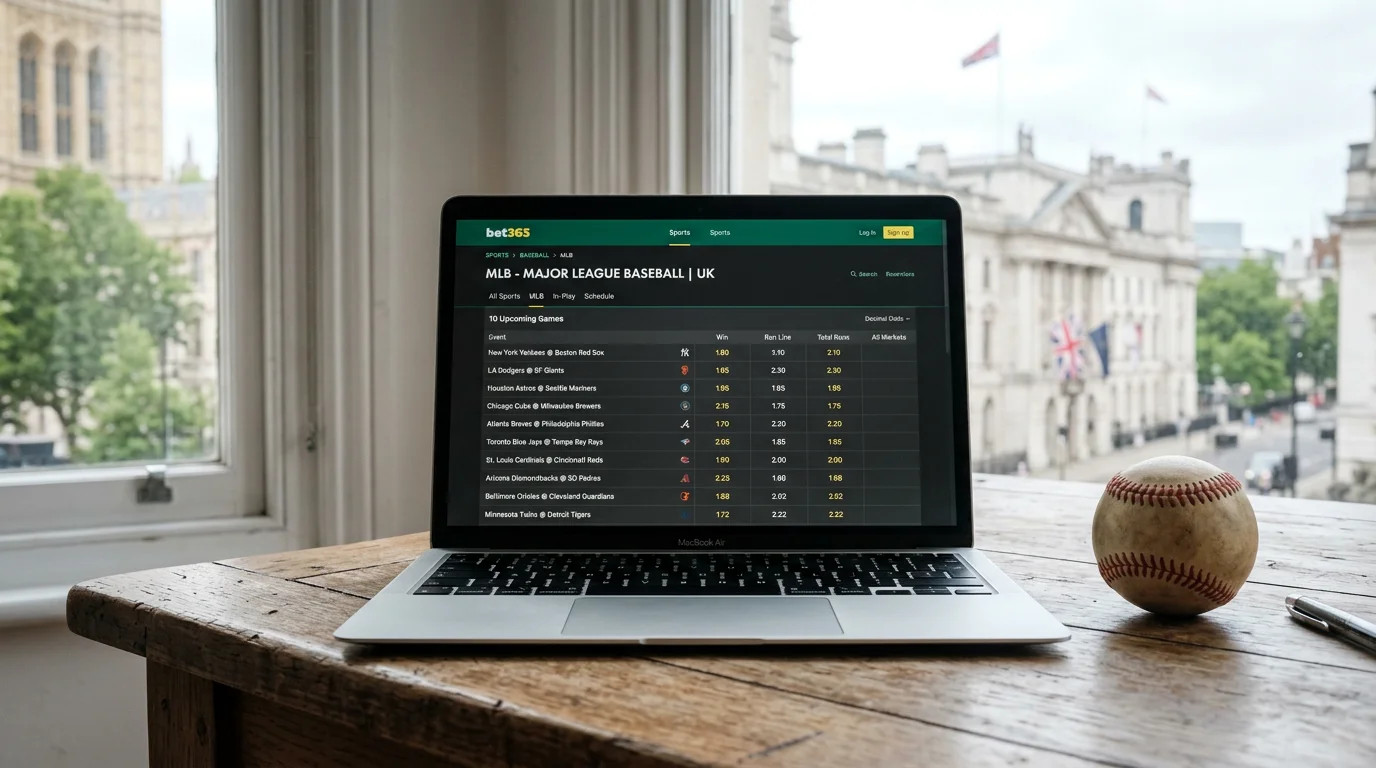
Table of Contents
- UK RGD Increase 2026: Sportsbook Margin Adjustments
- How RGD and GBD Apply to MLB Markets
- Operator Margin and Pass-Through Reality
- Bonus Generosity Will Compress
- The Black Market Risk Increases
- Worked Example: A Run-Line Price Through the Tax
- The Workflow Adjustment for 2026
- Common Questions on RGD and MLB Pricing
UK RGD Increase 2026: Sportsbook Margin Adjustments
I keep a notebook of MLB decimal-odds prices from the past six seasons, taken at the same UK-licensed sportsbook on roughly comparable matchups. The 2020 and 2021 prices on a typical run-line market sit slightly above the 2024 and 2025 prices. The gap is small – a hundredth of a decimal point here, sometimes two – but it is consistent. That is what regulatory cost looks like in retail-facing pricing. Tax does not appear as a line item on the slip. It appears as a slightly worse number at the top of the screen.
The 2026 reforms announced for UK gambling tax will move the Remote Gaming Duty rate from 21 percent to 40 percent and the General Betting Duty rate from 15 percent to 25 percent. Those are big headline jumps. The pass-through to retail prices will not be one-to-one (operators absorb part of the burden, especially on the most competitive markets), but the direction is clear: MLB decimal odds at UK-licensed books will be marginally worse from April 2026 than they were before. This guide walks through the mechanics of how the tax flows into the price screen, what the realistic compression looks like on common MLB markets, and how a UK bettor should adjust the line-shopping and bonus-evaluation workflow accordingly.
How RGD and GBD Apply to MLB Markets
The two duties cover different parts of the operator’s product mix. Remote Gaming Duty applies to remote casino, bingo and similar gaming products. General Betting Duty applies to fixed-odds betting, including sports markets like MLB. The headline 2026 rise from 15 percent to 25 percent on GBD is therefore the more directly relevant change for an MLB bettor’s prices.
The duty is calculated on the operator’s gross gambling yield, broadly the difference between stakes received and winnings paid out, on the relevant product. A 25 percent tax on yield does not translate directly to a 25 percent change in the price the customer sees, because the operator’s pricing builds margin (the overround) into every market and the tax compounds with that margin rather than replacing it. The arithmetic is closer to: a market priced at a 4 percent overround pre-tax will need to widen to roughly 5.5 to 6 percent overround post-tax to maintain the operator’s net margin, and that overround widening shows up as marginally shorter prices on each side of the market.
For an MLB run-line example, a typical pre-tax decimal price of 1.91 on the favourite and 1.95 on the underdog (around a 4 percent overround) might compress to 1.87 and 1.91 (around a 5.5 percent overround) under a fully passed-through tax rise. That is a four-hundredth-of-a-point reduction on each side. Across an entire MLB season placing 300 to 500 bets, the cumulative effect is real, even if any single bet barely registers it.
Operator Margin and Pass-Through Reality
Operators do not pass duty rises through fully because the market is competitive at the headline-market level. A UK-licensed sportsbook that compressed its run-line and moneyline odds by 5.5 percentage points of overround would be visibly less competitive than rivals who absorbed more of the cost. The realistic pattern is partial pass-through, with most of the visible compression happening on softer markets (player props, exotic specials) where the customer is less price-sensitive and the operator has more pricing latitude.
For an MLB bettor, that means the headline run-line and total markets will tighten less than the prop-bet markets. A Yankees-Astros run-line at 1.91 may move to 1.89 post-tax. A Yankees pitcher strikeout-prop over 6.5 may move from 1.92 to 1.86. The relative compression is heavier on the prop, because the operator’s margin baseline is larger and the customer’s price sensitivity is lower. The May 2025 marketing rules shape how bonuses can be promoted to offset some of this pricing pressure, but the underlying odds compression is structural.
The lobbying narrative around the duty rises has been that the tax burden risks pushing UK customers toward unlicensed offshore operators with structurally lower cost bases. David McLeish, partner at Wiggin LLP, captured the texture of the consultation in a January 2026 industry interview: “The industry’s lobbying effort felt much more coordinated and consistent than in previous cycles, but at times the policy’s rationale appeared muddled.” The argument that the duty rises hit the legal market hardest precisely because the legal market is the regulated, taxed, customer-protected option – while the black market does not pay the levy or the duty – has been pushed hard in regulatory consultations, although the headline rates have stayed where they were announced.
Bonus Generosity Will Compress
The most visible second-order effect of the duty rises will be in the bonus environment. UK-licensed sportsbooks fund bonus offers from operating margin. If margin compresses by even one or two percentage points net of duty, the bonus budget shrinks proportionally. The free-bet offers, deposit matches, and risk-free first bets that have been a familiar part of UK sports betting since the 2014 Point of Consumption Tax era will not disappear, but they will be smaller and more selective.
I expect the post-2026 bonus landscape to look like this: fewer mass-market promotions targeted at all customers; more targeted promotions aimed at retention of high-value customers; and shorter bonus windows around major events. Opening Day, the All-Star break, and the World Series will still attract promotional activity; the volume of mid-season offers around regular-season Tuesday-night three-game series will decline. Industry analysis has noted that nine times more free-bet offers are issued during major tournaments compared with off-season periods, and the post-2026 picture will likely concentrate that ratio further toward the major events.
For a UK MLB bettor, the practical adjustment is to value the major-event promotions more carefully because they will be relatively more important within a smaller overall bonus pool. The qualifying-bet mechanics, the rollover requirements, and the eligible-market restrictions deserve closer reading post-2026 than they did pre-2026. A 2025 free-bet offer with a flexible rollover and broad market eligibility is not necessarily what the 2026 equivalent will look like.
The Black Market Risk Increases
Gambling Commission analysis estimates the UK black market at around £500 million in annual stakes, and the 2026 duty rises are likely to push that figure higher rather than lower. The competitive logic is straightforward: if a UK-licensed sportsbook offers 1.89 on a market and an unlicensed offshore operator offers 1.95, the offshore price is more attractive at face value. The risk transfer is severe – no Gambling Commission protection, no GAMSTOP, no segregated customer funds, no statutory complaint mechanism – but the headline price is the customer-facing visible variable.
The right framing is that the 1.89 from a UK-licensed book is the genuinely available price for a UK customer who values the regulatory protection. The 1.95 from the unlicensed alternative is a price for a different product, with the same nominal market but materially different counterparty risk. A bettor who treats the two as comparable is mispricing the protection rather than getting better odds.
The cumulative effect on operator margins is the lever that determines whether the regulated market can compete on price with the offshore alternative. If the regulated market becomes structurally more expensive, displacement is the predictable outcome – and that argument has driven much of the industry pushback against the headline tax rates. The policy response – additional enforcement against unlicensed operators, payment-blocking measures, ISP-level interventions – is being shaped through 2026, but the policy gap during the transition is real.
Worked Example: A Run-Line Price Through the Tax
Suppose a UK-licensed sportsbook prices a Yankees-Red Sox game with the Yankees at -1.5 on the run line at 2.05 decimal odds and the Red Sox at +1.5 at 1.85, in early 2025. The implied probabilities are 48.78 percent and 54.05 percent, summing to 102.83 percent. The overround is 2.83 percent.
Post-2026, with full pass-through of the duty rise, the same market might be priced at 2.00 on the Yankees and 1.83 on the Red Sox. The implied probabilities become 50 percent and 54.64 percent, summing to 104.64 percent. The overround widens to 4.64 percent. The customer pays the additional 1.81 percentage points of margin in the form of slightly worse prices on both sides.
For a £20 stake on the Yankees side, the pre-tax expected payout was £41. The post-tax equivalent is £40. The £1 difference is the customer’s share of the duty rise on this single bet. Across 300 bets in a season at similar pricing, the cumulative cost is meaningful: the order of magnitude is £200 to £400 per season for a moderately active bettor, depending on average stake size. Line shopping across two or three UK-licensed books recovers some of that cost (the cheapest book on a given line typically beats the average by one or two hundredths of a decimal point), which is why disciplined line-shopping becomes proportionally more valuable in the higher-tax environment.
The Workflow Adjustment for 2026
The disciplined UK MLB bettor’s workflow does not need a wholesale change for 2026. The components – line shopping, bankroll management, granular consent settings, selective bonus evaluation – are the same. What changes is the relative weight of each component. Line shopping matters more when the average price is worse, because the available price spread between books contains a larger fraction of the customer’s edge. Bankroll discipline matters more when bonus generosity is lower, because the pre-bonus expected value of each bet is doing more of the work. Bonus evaluation matters more because each remaining bonus is a larger fraction of the available promotional pool.
I expect to spend more time on line shopping in 2026 than I did in 2024. The tooling has not changed but the marginal value of each two-hundredths-of-a-point pickup has gone up. Across 300 to 500 MLB bets in a season, a one-hundredth-of-a-point average improvement in the achieved decimal odds compounds into a measurable bottom-line difference. That ninety-second routine of checking three books before placing a bet is even harder to skip when the average book price is structurally worse than it was the year before.
Common Questions on RGD and MLB Pricing
Two questions come up most often when UK MLB bettors think about the 2026 duty changes and what they will see on the slip.
Will MLB decimal odds get measurably worse after April 2026?
Yes, although the visible change on the most competitive markets like the run line and moneyline will be small (typically one to three hundredths of a decimal point) because operators absorb part of the duty rise on price-sensitive markets. The compression will be more visible on player props, totals at non-standard lines, and exotic markets where the customer is less price-sensitive and the operator’s pricing latitude is wider. Disciplined line shopping across two or three UK-licensed sportsbooks recovers some of the cost, which is why the line-shopping workflow becomes proportionally more valuable in the post-April-2026 environment.
Does RGD affect betting duty on horse-racing or just casino?
Remote Gaming Duty applies to remote casino, bingo and similar gaming products and rises from 21 percent to 40 percent. General Betting Duty applies to fixed-odds betting on sports including MLB and rises from 15 percent to 25 percent. Horse-racing fixed-odds betting falls under GBD, but pool betting on racing has its own duty mechanism. For an MLB bettor, GBD is the relevant duty, and the 25 percent headline rate will compound with operator overround on every market priced after April 2026.
Published by the Betting on Baseball Tips team.