Coors Field Over Betting: Altitude and MLB Totals
 Available in US
Coors Field MLB Totals: Calculating Altitude Factors
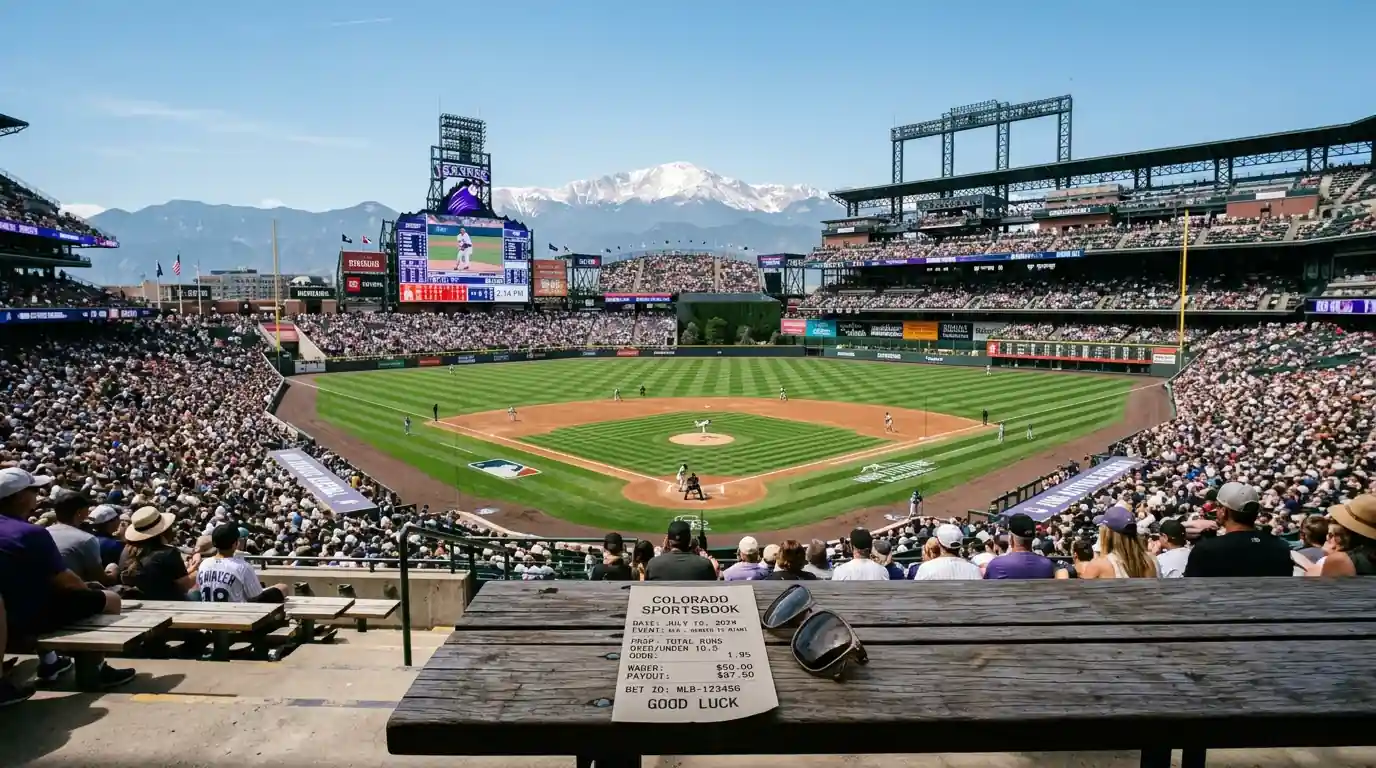
The first time I bet a Coors Field game I lost both ways on the same total. I bet the over because everyone said you bet the over at Coors. The line moved two runs after I placed it, the game went under that new line, and my ticket lost. The lesson was simple. Coors Field rewards punters who understand altitude as a quantitative input, not punters who treat it as a meme.
Park-factor data is unambiguous about how Coors warps the run environment. The home-run park factor at Cincinnati’s Great American Ball Park sits at 122. Dodger Stadium runs at 129. By contrast, Oracle Park reads at 77, PNC Park at 78, and Busch Stadium at 81. Coors sits at the extreme end of the run-scoring spectrum because of one variable that no other park can replicate – the altitude of the city the stadium sits in. Every total posted on a Coors fixture must be priced around that variable, and every UK punter looking to bet a Coors over must understand exactly how altitude bends the rest of the input chain.
This guide pulls apart the physics of how altitude affects ball flight, the operational reality of how the humidor partially neutralises that effect, the pitcher behaviour that compounds run-scoring at altitude, and the historical total trends that emerge once you weight the data correctly. By the end, the punter who walks into a Coors total holds the same edge a sportsbook trader holds – fluent in the variables, calibrated to the line.
The Physics of a Mile Above Sea Level
Denver sits at 5,280 feet – exactly one mile above sea level. The air at that altitude is roughly 80 percent as dense as air at sea level. Lower air density means less drag on a moving baseball. A struck ball travels further before gravity wins. The math behind this is unambiguous: a ball hit with the same exit velocity and launch angle in Denver carries roughly 5 to 7 percent further than the same ball would carry at sea level. On a typical 380-foot warning-track fly ball, that 5 to 7 percent translates to between 19 and 27 additional feet – the difference between a routine outfield catch and a home run that clears the wall by a comfortable margin.
The ball-flight effect is the most visible part of Coors physics, but it is not the only part. Lower air density also reduces the bite that breaking pitches generate. A curveball that breaks 12 inches at sea level will break roughly 9 to 10 inches at Denver altitude. A slider’s lateral movement compresses by similar margins. Pitchers whose primary out-pitch is a sharp breaking ball – the type that misses bats by inducing weak contact off the barrel – find that their stuff plays measurably softer at Coors. The hitter sees a flatter pitch on a more predictable trajectory. The barrel-contact rate climbs.
The home-run park factor of 129 at Dodger Stadium is the relevant reference point because Los Angeles is roughly at sea level. A 129 reading already means a park where home runs come 29 percent more easily than league average. Coors, with altitude pushing both ball carry and pitch flatness, reads at park factors well above 129 in raw seasonal data – sometimes north of 140 for runs and 130 for home runs. The variance is enormous and the punter must price it in.
What the Humidor Actually Does
The humidor at Coors Field has been the subject of more punter folklore than nearly any other equipment-storage facility in professional sport. The folklore says the humidor “fixes” Coors. The data says it modulates Coors but does not fix it.
The humidor was installed in 2002. Baseballs stored at high altitude in dry conditions lose moisture, become slightly lighter, and travel further when struck. The humidor maintains baseballs at a controlled humidity level – historically 50 percent, raised to 60 percent for the 2022 season – that mirrors the conditions in lower-altitude parks. A humidor-conditioned baseball is fractionally heavier and fractionally less elastic than an unconditioned ball. It travels less far when struck and the breaking-ball deformation pattern is closer to the league baseline.
The 2022 humidity adjustment shifted Coors run environment downward by an estimated 0.4 runs per game compared to the previous baseline. That is a meaningful adjustment but it does not eliminate altitude. Coors run-scoring environments still sit substantially above league average even with the humidor at full effect. UK punters who hear the words “the humidor neutralised altitude” are receiving a misleading summary. The humidor compresses the altitude effect by perhaps 30 to 40 percent. The remaining 60 to 70 percent of the altitude advantage is still operational on every Coors total. There is a wind-driven counterpart in Chicago that operates on similar physics, and the wind-driven counterpart at Wrigley Field deserves identical analytical respect.
How Pitchers Compound the Effect
Altitude does not act in isolation. Pitcher behaviour compounds the run environment because pitchers respond to the conditions in ways that further inflate scoring.
The first compounding effect is starter usage. Coors starting pitchers are pulled earlier than league average. The Rockies organisation has historically rotated starters off the mound in the fifth or sixth inning rather than letting them work into the seventh, because pitch-counts rise faster at altitude (more contact, more foul balls, more pitches per plate appearance). Earlier starter exits mean more bullpen innings, and bullpen ERAs at Coors are substantially higher than at league-average parks. The K%-BB% baseline is part of how this compounding shows up on the scoreboard. League-average K% sits around 22.2 percent and BB% around 8.4 percent, but Coors fixtures consistently produce K% below 20 percent and BB% above 9 percent because pitchers cannot trust their breaking stuff and end up working in the strike zone with safer pitches that get hit harder.
The second compounding effect is opposing-team pitcher selection. Visiting clubs entering Coors series often skip their best starters in the rotation, saving them for the next series at a more neutral park. The starter who pitches in the Coors series is frequently the third or fourth starter – a pitcher with worse strikeout rates, worse command, worse overall stuff. The aggregate quality of pitching that appears at Coors is below the aggregate quality of pitching that appears at sea-level parks, and the runs-allowed numbers reflect that quality differential as much as they reflect altitude.
The third compounding effect is the roster-construction decision Rockies management has historically made – the team employs hitters who can succeed at altitude (high contact, gap power) and accepts that those hitters will struggle on road trips. The home-road split for Rockies hitters has been one of the most extreme in the modern game. The home park’s run environment is amplified by the fact that the home team is built to score in the home environment. Visiting teams, by contrast, are built for league-average conditions and cope poorly when they walk into Coors.
What the Total Trend Actually Says
The total movement at Coors is consistent across seasons. Posted totals at Coors Field run roughly 1.5 to 2 runs higher than the same matchup would price at a neutral park. A pair of clubs whose normal fixture would price at 8.5 runs prices at 10 or 10.5 at Coors. A pair of clubs whose normal fixture would price at 9 runs prices at 10.5 or 11 at Coors. The book has already adjusted the line. The question for the UK punter is whether the line has been adjusted enough.
The data on Coors over-betting in the 2020s era is mixed. Across the 2022, 2023, and 2024 seasons combined – the period in which the 60 percent humidor humidity setting has been operational – Coors overs have hit at roughly 51 to 53 percent. That is meaningfully positive but it is not the slam-dunk margin that Coors lore suggests. A 52 percent over-rate is just barely above break-even on standard -110 American odds (which converts to roughly 1.91 decimal). On juiced lines of -115 or -120, the margin disappears entirely.
The conditions where Coors overs perform substantially better than the headline 52 percent are specific. Day games, especially in late spring and early summer when daytime temperatures push above 28 °C, push the over rate to roughly 56 to 58 percent because heat further reduces air density and lengthens ball carry. Games with two soft starting pitchers (combined ERA above 4.50) push the over rate north of 60 percent. Games where the wind is blowing out (rare at Coors, which sits in a relatively still bowl) push the over rate above 60 percent.
The conditions where Coors overs perform poorly are also specific. Night games in May or April, when Denver overnight temperatures can drop below 10 °C, see the over rate fall to roughly 47 to 49 percent. Games featuring elite starting pitching (combined starter ERA below 3.30) underperform the broader Coors over baseline because elite stuff retains enough of its altitude-adjusted shape to suppress contact. Games played in damp weather conditions also underperform because moisture in the air partially counteracts the dry-altitude carry effect.
The discipline is to bet Coors overs selectively. The blanket “always bet over at Coors” approach barely beats break-even and loses to vig. The targeted approach – overs in hot day games against soft pitching matchups – produces a 56 to 60 percent hit rate, which is genuinely profitable territory. UK punters who price Coors overs with that specificity walk away with the edge. Punters who blanket-bet every Coors over get ground down by variance and vig.
Coors Total Questions UK Bettors Ask
Two questions dominate the reader inbox on Coors Field. One asks whether the over is always the correct bet at altitude. The other asks whether the humidor has actually neutralised the altitude effect. Both deserve direct answers, because both touch the core misconception that punts away the edge.
Should I always bet the over at Coors Field?
No. The blanket ‘always bet the over’ approach hits at roughly 51 to 53 percent across recent seasons, which barely covers vig on -110 American odds and loses on juiced lines. Coors overs perform substantially better in specific conditions: hot day games above 28 °C, soft starting-pitcher matchups with combined ERA above 4.50, and games where the wind is blowing out. Selectively targeting those conditions produces a 56 to 60 percent hit rate. The discipline is to bet selectively rather than blanket-bet.
Does the humidor actually neutralise altitude in Denver?
No. The humidor compresses the altitude effect by roughly 30 to 40 percent, with the 2022 humidity adjustment to 60 percent shifting run environment down by approximately 0.4 runs per game from the previous baseline. The remaining 60 to 70 percent of the altitude advantage is still operational on every Coors total. UK punters who treat ‘the humidor fixed Coors’ as fact are receiving a misleading summary – Coors run environments still sit substantially above league average even with the humidor at full effect.
Prepared by the Betting on Baseball Tips editorial staff.