NPB Betting Tips UK: Japanese Baseball Markets
 Available in US
NPB Betting UK: Pacific League Pitching and Totals
I will admit it: the first time I bet an NPB game, I did so because I had finished my morning coffee and the KBO slate had run dry. What I expected was an exotic curiosity. What I found was a more disciplined, more pitching-rich version of the same Asian baseball pocket KBO occupies – but with a different rhythm and a different edge profile. NPB games typically first-pitch around 11:00 BST, which is later than KBO and earlier than the MLB pre-game window. They sit perfectly between coffee and lunch, and they reward the same patience as MLB without the 02:00 wake-up.
The UK is, by some margin, the largest European market for MLB by broadcast revenue, merchandise sales, and digital subscriptions, ranked behind only Mexico, Japan, South Korea, China and Australia globally. That puts the UK punter closer to Japanese baseball than most British people realise, and the existing betting infrastructure at major UK-licensed sportsbooks reflects it. NPB is not a fringe market on the slip; it is a core Asian-league offer at every operator I use regularly.
Central League vs Pacific League
NPB is two leagues, six teams each, with a structural difference that changes every betting decision. The Pacific League uses the designated hitter; the Central League historically did not, although recent rule changes have softened that boundary. The DH versus pitcher-batting distinction translates into a measurably higher run environment for the Pacific League – typically half a run per game more than the Central League across a typical season. Punters who treat the two leagues as identical lose money in their first month.
The Pacific League also tends to play in larger, marginally more pitcher-friendly stadiums on average, which partially offsets the DH effect. The net is that PL totals run roughly 0.3 to 0.5 runs higher than CL totals, but with less variance around the mean. CL games have wider variance because pitchers batting introduce more zero-run innings, and inversely, more crooked-number innings when the bottom of the order rallies. Treat the leagues as separate samples, not as one league.
The two leagues meet in interleague play during a defined June window each season. Interleague games are scored differently in betting terms: PL teams hit better in CL parks because they are accustomed to lineups with the DH, and CL teams pitch better in PL parks because they are not exposed to bullpen-shortening pinch-hitting decisions. Interleague NPB has historically produced more PL victories than the underlying numbers would predict, and UK books generally price this correctly, but not always.
Form across the leagues runs differently. CL teams play 143 games per season, the same as PL teams, but the playoff format gives the regular-season winner a structural advantage that under-prices late-season form. The CL post-season Climax Series is shorter than its PL equivalent, which compresses risk and rewards regular-season strength.
NPB Pitching Culture and Total Lines
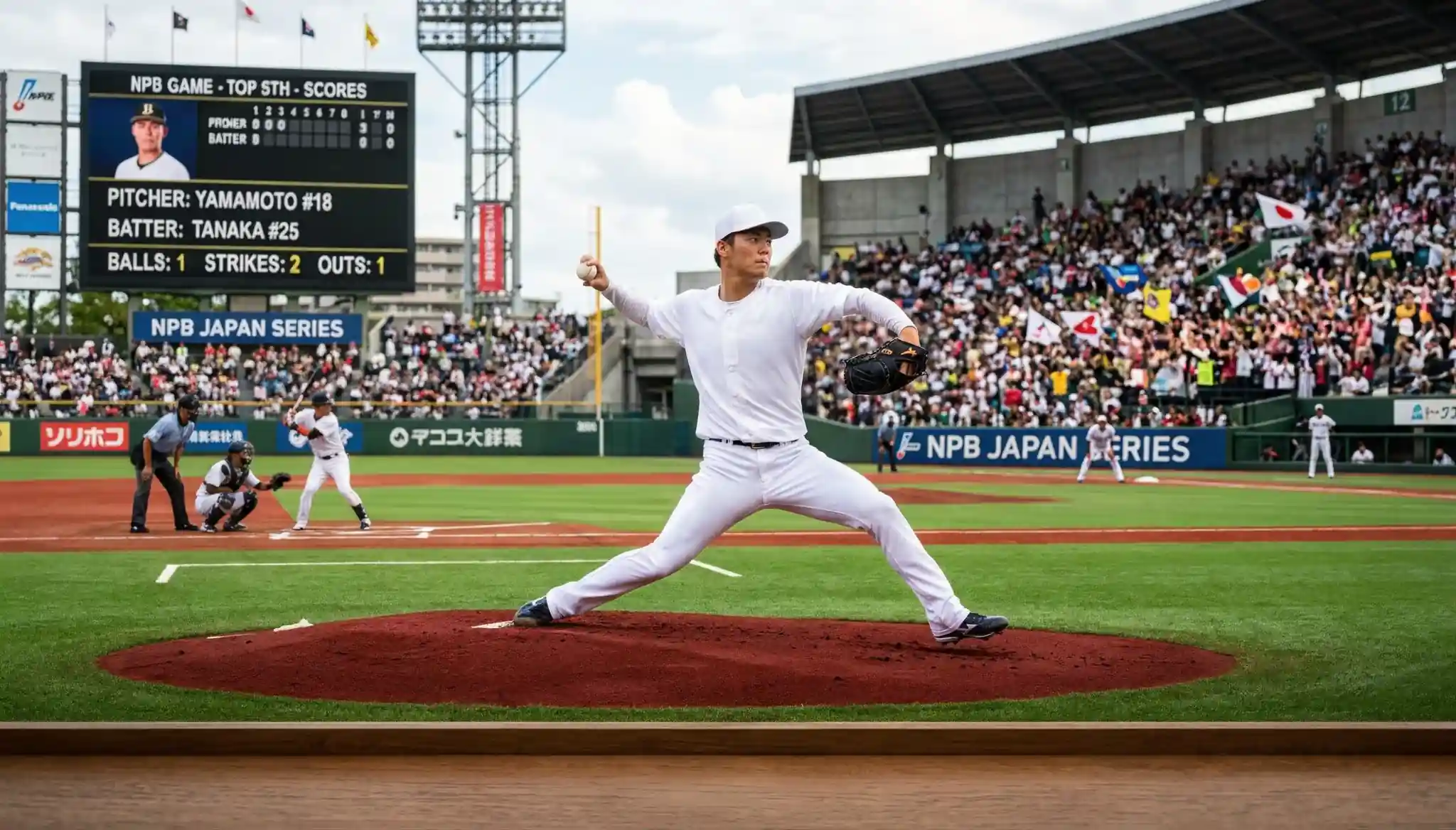
The single most distinctive feature of NPB compared to MLB is its pitching culture. NPB starters are babied less than MLB starters in some ways and more in others. They are routinely allowed to throw 120 to 130 pitches in a complete game; they are also given a six-day rotation rather than MLB’s five-day, which gives more recovery between starts. The result is a league where complete games are roughly three times more frequent than in MLB, and where the best starters reliably go deep into games.
The practical betting effect is that bullpen variance plays a smaller role in NPB total lines than in MLB. When a top NPB starter is on the mound, you are essentially betting on a starter for nine innings rather than for six. The over on a total line gets a weaker boost from late-innings bullpen meltdowns than it does in MLB; the under is structurally favoured when both starters are above-average.
Pitch-mix culture differs too. NPB starters typically have larger pitch repertoires than MLB starters – five to six different pitches is common, and forkball/splitter usage is roughly double the MLB rate. That repertoire generates more swings-and-misses and fewer barrels. A starter with a 25 % K rate in NPB is essentially a 28 % K-rate equivalent in MLB, because the barrel suppression is doing additional work the headline number does not capture.
Total lines on NPB are consequently set lower than MLB equivalents – often 6.5 or 7.0 against an MLB-typical 8.5 or 9.0. The league-wide runs-per-game number sits around 7.5 in the Central League and 8.0 in the Pacific League, which lines up with the published totals. Where edge appears is in nights when a top starter goes against a slumping bullpen team – the under at 6.5 in that scenario is meaningfully under-priced, because the complete-game reality of NPB suppresses the late-innings variance the under-bet is exposed to in MLB.
Foreign starters in NPB – typically Americans on multi-year deals – bring MLB-style numbers but adapt to the NPB strike zone, which is slightly larger than MLB’s. Their first season often sees a marginal K-rate spike as they take advantage of the wider zone. Backing a foreign-import starter in his second NPB year, after the league has adjusted, is a different bet from backing him in his first.
UK Bookmaker Markets and Stake Limits
Coverage of NPB at UK-licensed sportsbooks is more uneven than coverage of MLB. The major operators all offer the moneyline, run line and total. Player props are thinner – most UK books cover only basic batter and pitcher props for NPB, and the price quality on those props is wider than on equivalent MLB markets. The depth of the slip is what separates a good NPB book from a thin one, and that distinction is worth checking before depositing.
Stake limits on NPB run small at most UK books. Where an MLB run line might accept a four-figure ticket without flinching, an NPB run line at the same operator might cap at £200 or £300. This reflects lower betting volume on the league rather than any specific operator policy. For a recreational UK punter staking 1-2 units per bet, the limits are rarely a problem; for anyone scaling up, they bind quickly. Sister coverage on this site for the KBO sister piece on Korean baseball runs through similar terrain.
Live in-play NPB coverage is genuinely limited. Some UK books refresh prices once or twice per inning rather than once per pitch, and the time delay between live action and price update can be 30 seconds or more. That latency cuts both ways – it lets a sharp punter exploit a price that has not yet caught up to a scoring play, but it also means the price quoted on screen may already be stale by the time you click confirm.
Outright markets on the Japan Series are typically priced with a 1.20 to 1.30 overround across the field, similar to KBO, which is wider than MLB outright. That overround means an NPB futures bet needs a meaningful overlay versus your own probability assessment to justify the seven-month lock-up. I rarely play NPB futures myself, because the price quality is too thin to justify the dormancy.
Worked Example: NPB Run Line at 11:00 BST
Suppose two Pacific League sides meet, with the home favourite carrying a 25 % season win-rate edge over the visitor in matchups against right-handed starters. The home starter is a foreign import in his second NPB year, season ERA 2.85 with a sub-3.00 FIP. The visiting starter is a domestic veteran with an ERA near 4.00. The run line at -1.5 on the home side opens at 2.10 at a UK book.
Implied probability at 2.10 is 1 ÷ 2.10 = 0.476, or 47.6 %. I build my own. NPB run-line hit rates on heavy favourites at -1.5 typically run roughly 50-55 %, similar to MLB but with slightly tighter distributions because of the lower bullpen variance. With a clear pitching mismatch and a home-park edge, my honest estimate is closer to 52-55 %.
The 52-55 % real against 47.6 % implied is a genuine overlay. A £15 stake at 2.10 returns £31.50 with £16.50 profit. I would size at 1 unit. The discipline at this morning hour is to take the bet I have prepared and resist staking on the second game of the slate just because I have time before lunch – the second game has not been worked, and the price has not been verified against an honest probability assessment.
One last calibration: NPB win probabilities are stickier than MLB equivalents. A 70 % implied favourite at the moneyline is actually closer to 72 % real because of the structural weight the favourite carries through six innings of starting pitching. Decimal prices on heavy NPB favourites, particularly home favourites with a foreign-import ace, are systematically slightly under-priced at UK books. That overlay is small but real, and across thirty NPB selections per season the maths compounds.
NPB Questions UK Bettors Ask
The questions readers send me about NPB cluster around two practical concerns: whether the run line works the same way as it does in MLB, and which UK books actually price the league with any consistency. Both are worth answering directly, because both shape what is and is not stakeable.
Are NPB run lines structured the same way as MLB run lines?
Yes, NPB run lines on UK-licensed sportsbooks are structured at -1.5 and +1.5 in the same format as MLB. The implied probability differs because of NPB’s lower run environment and stronger starting-pitcher culture, which produces fewer one-run games than MLB and a slightly different distribution of margins. Backing a strong home favourite at -1.5 in NPB tends to be a marginally better proposition than the equivalent in MLB, because the lower bullpen variance lets the favourite finish off close games more cleanly.
Which UK bookmakers consistently price NPB markets?
Most major UK-licensed sportsbooks now offer the NPB moneyline, run line and total throughout the regular season, with player props available at a smaller subset of operators. Coverage is most reliable during the regular-season May to October window and thinner during the off-season. Stake limits on NPB tend to be lower than MLB equivalents, often capping in the low hundreds of pounds, which reflects lower betting volume rather than any specific UK operator policy.
Written by the editors at Betting on Baseball Tips.