MLB London Series Betting: UK Markets and Decimal Odds
 Available in US
MLB London Series: Pitching and Stadium Run Factors
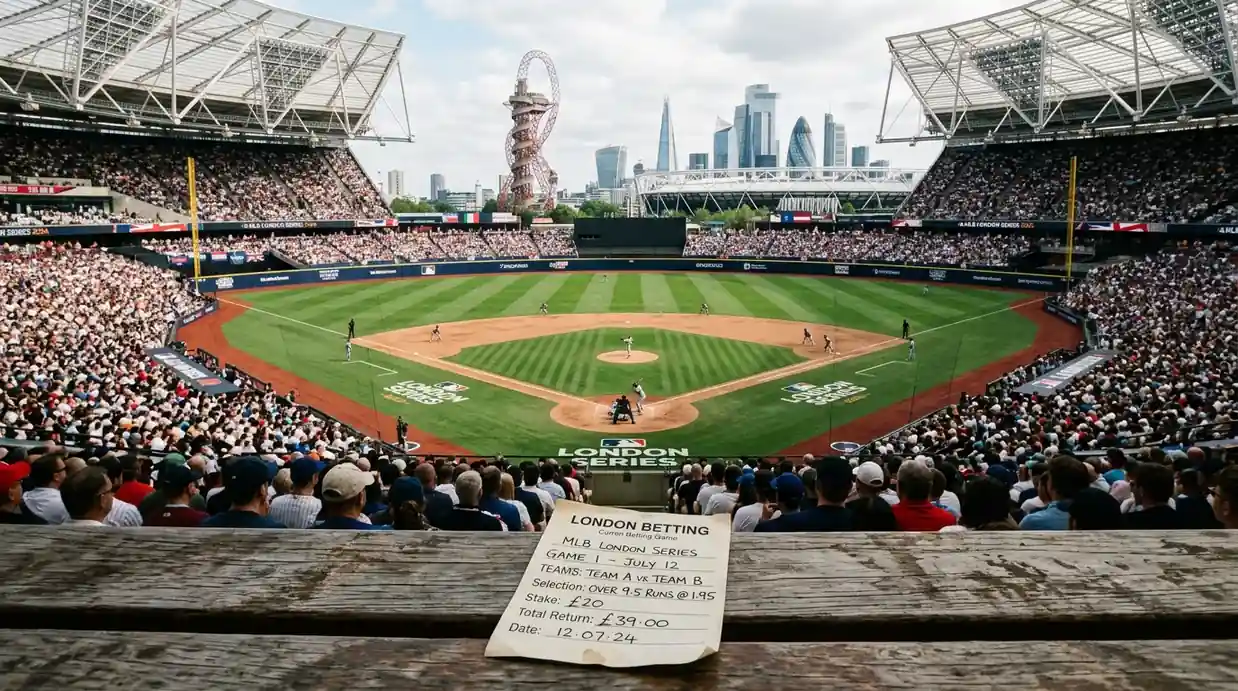
The first London Series game I bet from a sofa in west London is one of the few MLB experiences I can describe sound-by-sound. The crowd’s reaction to the first pitch – half cheer, half awkward silence as people remembered they did not actually know when to clap – set the tone for a genuinely strange but wonderful weekend. There were UK punters in the stands clutching betting slips with prices they had checked thirty times that morning. There were Americans visibly bemused by the British in-stadium pricing display. And there was, finally, an MLB game I could bet pre-match at 16:00 BST and watch in-play through to a 22:00 finish without sacrificing my sleep.
The London Series is the only MLB event each year that genuinely fits the UK bettor’s life. Two days, two games, both at sensible British hours, both broadcast cleanly into UK homes, both supported by the deepest in-play coverage UK books offer all year. As Sadiq Khan, the Mayor of London, summed up the 2024 fixture: “London is the sporting capital of the world and it was fantastic to have the New York Mets and Philadelphia Phillies play a series this summer, delighting fans and providing a significant boost to the capital’s economy.” From a pure betting perspective, those two days are the most efficient and most punter-friendly slate in the entire MLB calendar.
Attendance and Economic Footprint
The 2024 London Series, which featured the New York Mets against the Philadelphia Phillies, drew a combined 108,956 spectators across the two days at London Stadium. That is a remarkable number for two MLB games staged a continent away from the league’s usual fanbase, and it reflects a market that has grown organically rather than through forced exposure. The series also generated a direct economic impact of £56.5 million for London, with an additional £9 million flowing to other UK regions through ancillary spending – hotel nights, train tickets, hospitality. By any reasonable measure, the event has been a success for both MLB and the city.
The economic footprint matters for bettors because it tells you something about the structural durability of the fixture. A one-off curiosity does not generate £56.5 million; a recurring institution does. MLB’s broader UK strategy – through the BBC Sport and TNT Sports broadcast partnership, through the £56.5 million London showcase, through the deliberate growth-market positioning – adds up to a clear signal that the league treats the UK as a genuine commercial priority. Betting markets respond to that durability with deeper coverage, sharper prices, and more sophisticated in-play infrastructure than the regular-season slate typically receives.
The 2024 attendance figure of 108,956 also tells you something operational: the stadium can absorb a crowd of that size for a baseball-format game, even with the awkward retrofit of a football venue into a baseball field. Future London Series fixtures will not be capped by capacity issues – they will be limited only by the league’s willingness to schedule them and by the host stadium’s other commitments. The 2026 fixture was cancelled exactly because of that second constraint: West Ham’s Premier League schedule could not be reconciled with a June MLB slot. The series returns in subsequent years, with the underlying commercial logic intact.
For UK punters specifically, the attendance and economic numbers translate into thicker betting markets. UK books treat London Series fixtures like a marquee event rather than a regular-season game, which means deeper market depth, broader player-prop coverage, and – most importantly – competitive pricing across operators. Line shopping across two or three UK books is most rewarding precisely on London Series weekend.
London Stadium as a Baseball Park
London Stadium was built for athletics and adapted for football, with neither sport sharing baseball’s specific dimensional requirements. The retrofit for an MLB fixture involves a temporary diamond, temporary outfield walls, and temporary seating reconfigurations that produce a baseball field meaningfully shorter in the outfield than most MLB parks. The Mets-Phillies series in 2024 saw a combined 13 home runs across two games, which was high relative to similar matchups at the teams’ home parks during the same season.
For totals betting at the London Series, this matters a great deal. The temporary park dimensions push the run environment hotter than the season norm by an estimated 0.5 to 0.8 runs per game. UK books that base their London Series totals on regular-season run rates without the park adjustment are systematically under-pricing the over. The over has hit consistently in past London Series fixtures, and UK punters who model the dimensional change rather than accepting the headline total have captured a real edge.
Wind and weather effects are smaller in London than at outdoor US parks because the stadium’s bowl design and the typical British June weather both reduce wind influence. London June weather sits in the 16-22 °C range, with light winds and limited humidity – conditions that mute carry slightly compared to a US summer afternoon. The smaller park dimensions outweigh the smaller weather effects, so the net is still a hotter run environment than a generic MLB game.
The pitching mound at London Stadium is constructed to MLB specifications, which means starters do not face mechanical adjustment beyond the unfamiliar setting. What does affect pitchers is travel – both teams arrive in London after a transatlantic flight, with two-day acclimatisation at most before first pitch. The pitching staff that travelled best (typically the team that arrived earlier and used the time more strategically) has historically performed slightly better in the series, though the sample is small.
Lineup quirks also matter. Both teams typically rest one or two regulars across the two-game series to manage travel fatigue, and the lineup card released ninety minutes before first pitch occasionally surprises punters expecting a normal full strength roster. Confirmation of the lineup before staking is more important at the London Series than at a typical MLB fixture.
The Daytime UK In-Play Window
The London Series schedule typically places Saturday’s game at 18:30 BST first pitch and Sunday’s game at 13:30 BST first pitch. Both fixtures finish well within UK evening hours – Saturday around 22:00, Sunday around 17:00. For UK in-play betting, this is the only MLB window in the entire calendar where a punter can engage live, fully, comfortably, and across the entire game.
UK book in-play coverage is at its broadest during the London Series. Markets that typically run thin – same-game accumulators, alternate run lines, inning-specific run totals, pitcher-by-pitcher props – open at major UK operators specifically for the London weekend. Latency between live broadcast and in-play price update narrows because UK servers and UK fan demand pull operator infrastructure toward maximum responsiveness. The result is an in-play environment that more closely resembles a Premier League match’s depth than a regular-season MLB fixture’s depth.
The pre-match window also runs longer than usual. Where an MLB regular-season pre-match window opens roughly 24 hours ahead, London Series pre-match windows often open 96 to 120 hours ahead, giving punters multiple days to model, compare prices, and place pre-match positions before line movements compress the value. Early entries in the pre-match window have historically captured the largest edges, particularly on totals and player props that adjust as the lineup news arrives. For a complementary view of how the broader UK time-zone calendar shapes betting decisions, the UK time-zone schedule guide pulls together the bigger-picture timing piece.
I treat London Series weekend as the single most concentrated betting opportunity of the calendar year. Two games, multiple market types, comprehensive in-play coverage, sensible UK hours, deeper book coverage. The discipline is to prepare in the days leading up to the series, place pre-match bets early, and use the in-play windows for executions of pre-modelled positions rather than reactive improvisation.
What the 2026 Cancellation Means
The 2026 London Series, originally scheduled to feature the New York Yankees against the Toronto Blue Jays, was cancelled because of a fixture conflict with West Ham’s Premier League schedule. The London Stadium hosts West Ham for the bulk of the football season, and the gap that had previously accommodated the MLB fixture in June was unavailable in 2026 because of late-season Premier League fixtures pushing into the original window.
For UK punters, the practical implication is one missing weekend in the 2026 betting calendar – the most concentrated opportunity of the year, gone for one season. The series is expected to return in subsequent years, with MLB and the Mayor of London’s office both publicly committed to the institution. The 2027 fixture is likely to feature one of the marquee matchups MLB has been holding for major UK exposure (a Yankees-Mets series has been mentioned as a long-term possibility, though no announcement has been made).
The cancellation also suggests something about how UK MLB events scale. Every London Series fixture requires multi-year coordination across MLB scheduling, the Mayor of London’s office, the host stadium operator, and UK broadcast partners. When any single piece of that coordination breaks, the fixture cannot simply be rescheduled to a different weekend. UK punters who have come to depend on the annual showcase will need to plan their 2026 calendar around its absence.
One marginal positive: with the London Series gone for 2026, the betting attention that would normally concentrate on that weekend disperses across the rest of the regular-season slate. UK books may run mid-summer marketing and pricing promotions that they would otherwise have reserved for the London weekend, and pre-match prices on regular-season MLB fixtures during June 2026 may be marginally sharper as a result. The compensation is small, but it is real.
London Series Questions UK Bettors Ask
Two questions dominate the reader inbox about the London Series. One concerns the dimensions of London Stadium and how they affect totals betting; the other concerns the 2026 cancellation and the timetable for the series to return. Both deserve direct answers because both shape the bet selection on this fixture.
How do dimensions at London Stadium affect baseball totals?
London Stadium is built for athletics and adapted for football, with neither sport sharing baseball’s outfield dimensions. The temporary baseball retrofit produces a smaller outfield than most MLB parks, which pushes run environments hotter by an estimated 0.5 to 0.8 runs per game compared to season averages. UK books that base London Series totals on the teams’ regular-season run rates without adjusting for the dimensional shift have historically under-priced the over. The 2024 Mets-Phillies series saw 13 combined home runs across two games.
Why was the 2026 London Series cancelled and when does it return?
The 2026 London Series, originally scheduled to feature the New York Yankees and the Toronto Blue Jays, was cancelled because of a fixture conflict with West Ham United’s Premier League schedule at London Stadium. Late-season Premier League fixtures pushed into the June window MLB had previously used. The series is expected to return in subsequent years, with MLB and the Mayor of London’s office publicly committed to the institution. No specific 2027 matchup has been confirmed at the time of writing.
Written by the editors at Betting on Baseball Tips.