World Series Futures Betting UK: Outright Markets
 Available in US
World Series Outrights: Managing Mid-Season Probability
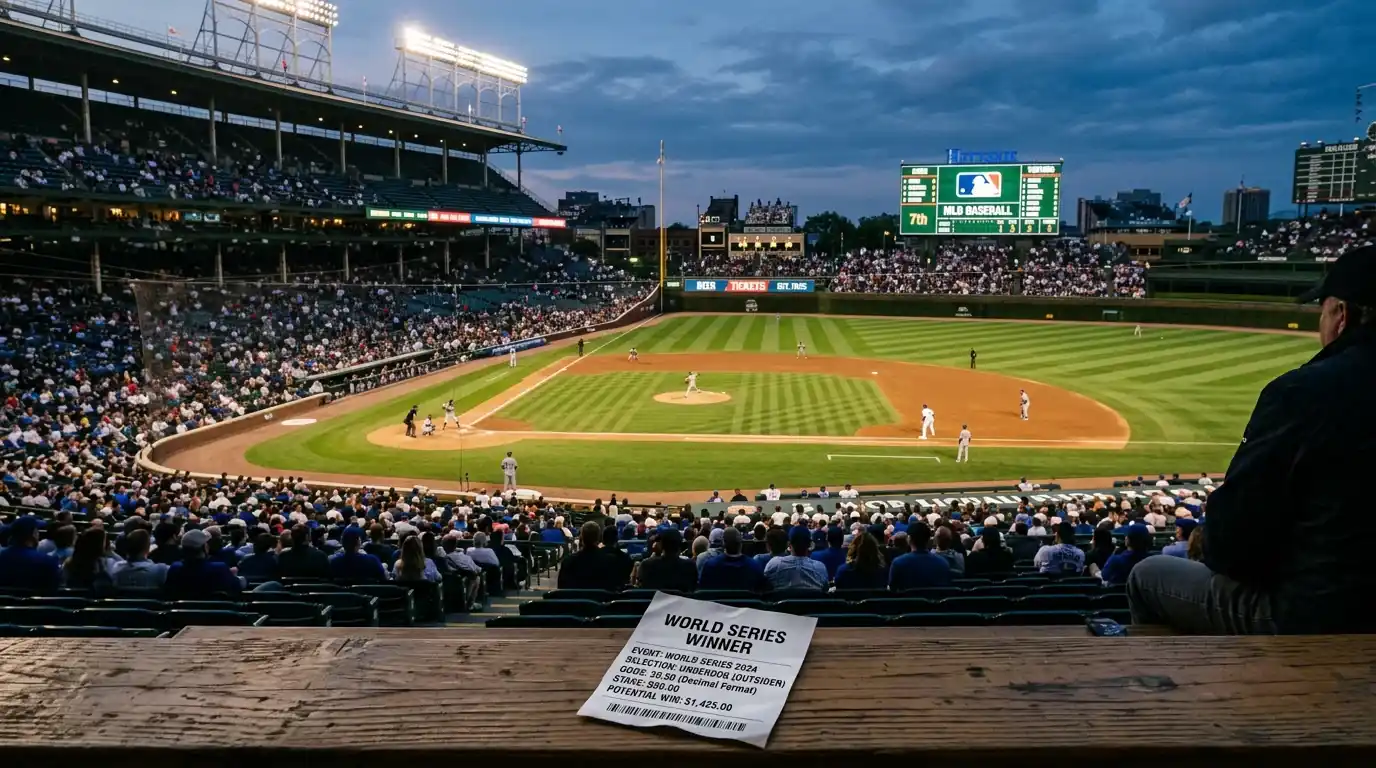
A reader emailed me one February asking why his £50 outright bet on a 12.0 World Series ticket placed in March, on a team that had already been eliminated by August, hadn’t been refunded “the way ante-post football works in the UK.” The honest answer was that futures, by their nature, do not refund. Once the ticket is graded as a loss because the team did not advance, the stake is gone. That mechanic is the single most important feature of MLB futures markets and the source of every mistake retail punters make on them.
A futures bet is a long-dated, illiquid position. You stake now, you get an answer in October or November. In between, the price you bought at may look better or worse than the live price, but you cannot harvest those changes – the ticket sits in your account, dormant, until settlement. The 162-game regular season and 2,430 league-wide games per year provide context the moment you stake: you are committing capital across roughly seven months of baseball, and the lock-up cost is real.
Implied Probability and Book Margin on Outrights
The first thing I do with any outright market is sum the implied probabilities and compute the book’s margin. On a 30-team World Series outright market, taking the reciprocal of every decimal price and adding the results, the total should mathematically be 1.00 if the market were fair. In practice it sits between 1.18 and 1.30 depending on the operator – that is the book’s edge baked across the field.
An 18 % to 30 % overround is dramatic compared to a 4-6 % moneyline market. The reason is liquidity and risk: outrights are long-dated, books cannot easily lay them off, and the margin compensates the operator for tying up risk capital from March until late October. As a punter, that means every bet you make on an outright is essentially overpaying by a meaningful percentage relative to the equivalent in-game market. The decision is whether the price you find specifically is mispriced enough within that overpriced field to be worth the lock-up.
I work it the other way: I take the team I think is genuinely 8 % to win the World Series, find a UK book pricing them at decimal 14.0 (which is 7.1 % implied) and ask whether the gap – 8 % real against 7.1 % implied – is worth tying up capital from March to October. The answer is rarely yes for a single team. The answer becomes yes more often if I can spread two or three small positions across teams I think are systematically mispriced, building a small portfolio rather than a single ticket.
Margin patterns vary by team within the same market. Big-market favourites are typically priced thinner – closer to fair – because public money pours in and books need the price to be realistic. Mid-tier teams in the 20.0-40.0 range are where books pad margins most aggressively, because the public ignores them. That is where edge tends to live, but only if your read on the team is genuinely sharper than the book’s.
When Outright Prices Move: Three Windows
I divide the futures calendar into three pricing windows. The first is November to January, the off-season window, when prices move on free-agency signings and trades. A 12.0 team that lands a frontline starter can compress to 9.0 within forty-eight hours of the announcement. A 22.0 team that loses an MVP-level player can drift to 35.0 just as fast. The off-season window rewards punters who follow MLB transactions actively and pounce within the day.
The second window is March, opening week. Prices typically widen briefly around opening weekend as the public money lights on early returns – a strong opening week pulls prices in, a slow start pushes them out, often disproportionately to what the small sample warrants. The third or fourth weekend of April is where I typically find my best secondary entry prices, because by then the early-season volatility has mostly settled and the underlying team strength is reasserting itself.
The third window is the trade deadline in late July and early August. Teams that load up at the deadline get aggressive price compression; teams that sell get price extension. A team that was 8.0 in mid-July can be 5.0 by 1 August after acquiring an ace. A team that sells off and falls back to a 25.0 rebuilder is functionally dead for futures purposes, regardless of where the price sits. The deadline is also where the smartest hedging windows open – more on that next.
The post-season itself is a fourth, narrower window where outright prices on remaining teams compress dramatically with each round won. A team that started March at 16.0, dropped to 9.0 at the deadline and 4.0 entering the LCS still has implied probability rising round-by-round as the field shrinks. Pre-season tickets at 16.0 on a team that reaches the LCS are now sitting on substantial mark-to-market value, even if the ticket has not yet settled.
In-Season Hedging on Outright Tickets
Hedging an outright ticket means staking on opposing outcomes during the post-season to lock in profit regardless of result. The discipline is to treat the original ticket as a fixed liability and ask, given the current decimal prices on the remaining teams, what hedge stakes would produce the same net profit no matter who wins. The maths is straightforward but unforgiving – a single sloppy stake size locks in less profit than the optimal split.
Suppose I bought a team at decimal 16.0 in March for £20. They are now in the World Series, priced at 1.85 to win the title. The opposing team is priced at 2.05. If I do nothing, I either win £300 or lose £20. If I hedge by staking £150 on the opponent at 2.05 – total return if the opponent wins is £307.50, of which £150 is the hedge stake and the remaining net is essentially break-even after factoring the lost original stake – I have effectively guaranteed a positive outcome regardless of result. The exact hedge maths depends on the prices and stake size, but the principle is constant.
I generally hedge once a futures ticket reaches the LCS round, not before. Earlier hedges leak too much value to the book’s margin; later hedges run the risk of the opposing team winning before the hedge is placed. The LCS is the sweet spot – enough probability has compressed that the hedge price is worth taking, but enough uncertainty remains that the hedge stake is a meaningful portion of the upside. I cross-reference the hedge plan with my bankroll workflow before placing the second leg, because hedging is itself a staking decision and needs to fit the broader unit-sizing structure.
UK-licensed sportsbooks generally treat outright hedging as standard play, and there is nothing irregular about staking both sides of a market on the same operator. Some books have offered “cash out” features that effectively pre-compute the hedge for you and offer a single button – the rate is invariably worse than the manual hedge, sometimes meaningfully, so I do my own maths rather than take the cash-out price.
One important warning: hedging is not free. Each hedge stake pays the book’s margin again. Hedging a ticket twice – at the LDS and again at the World Series – usually surrenders more value than it locks in, and the smart play is one clean hedge, not multiple incremental ones.
Worked Example: A Pre-Season WS Bet at 12.0
Suppose a team enters spring training with a 12.0 World Series outright price at a UK book in early March. Implied probability is 1 ÷ 12.0 = 0.083, or 8.3 %. I rate the team at 9 % real probability based on roster, pitching depth, and division strength. The 0.7-point gap is a thin overlay, and I would normally pass – futures with sub-1-point edges rarely justify the seven-month lock-up.
If the price drifts to 14.0 by early April after a slow start, implied probability falls to 7.1 %, and the gap widens to 1.9 percentage points against my 9 % rating. That is a stake-able position. A £15 stake at 14.0 returns £210, of which £195 is profit, on an event that should occur roughly 9 % of the time. Across a portfolio of three to five futures positions per season, each at similar overlays, the expected return turns positive.
By the trade deadline, suppose the team has held form, the price has compressed to 7.5, and they have made a meaningful pitching addition. My re-rated probability is now 14 %, against an implied 13.3 %. The original ticket is sitting on substantial mark-to-market value – implicitly, a 14.0 ticket with the price now at 7.5 has roughly doubled in expected value. Hedging is not yet warranted because the LDS has not begun. I let the ticket run.
If the team reaches the World Series at decimal 1.85 to win the title, my £15 ticket at 14.0 represents an open profit window of £210 minus £15 stake. A £75 hedge on the opponent at 2.05 returns £153.75 if the hedge wins, roughly equalising the net position at around £130-£140 of profit regardless of result. That is a clean exit on a single futures ticket, executed without ever touching the original stake after March.
Futures Questions UK Bettors Ask
Two questions come up in nearly every email I receive about futures: when to enter, and whether hedging is even available at UK books. Both deserve clean answers because both have a slightly counter-intuitive correct response.
When should I place a World Series futures bet for the best price?
The two best entry windows for World Series futures are typically late April, after early-season volatility has settled but before mid-season form locks prices in, and the immediate aftermath of off-season free-agent signings or trades, where prices can move overnight. The trade deadline in late July is a third window for re-entry on improved teams, but the price compression after a major addition is usually too rapid to catch unless you act within hours.
Can I hedge a futures ticket on a UK-licensed sportsbook?
Yes, hedging an outright futures ticket on a UK-licensed sportsbook is standard play and entirely legitimate – you simply place a fresh wager on opposing outcomes once the original ticket reaches a stage where hedge prices are favourable. Most UK books also offer a cash-out feature that pre-computes the hedge value, but the cash-out price is typically worse than calculating and placing the hedge manually. Hedging at the LCS round produces the cleanest profit lock; earlier hedges leak too much margin.
Prepared by the Betting on Baseball Tips editorial staff.